Forest Bathing – A Mindful Path To Nature Connection
Mental Health / ConservationAt TCV, we know that nature has a powerful way of restoring us – body, mind and spirit. Whether you’re planting bulbs in a community garden or simply pausing to feel the breeze through the trees, these moments of connection matter. In this guest blog, TCV Greenzine reader, author and wellbeing advocate Vanessa Potter, whom we came across through our team in Croydon, explores the gentle yet transformative practice of forest bathing.
Drawing on science, personal stories and the growing ParkBathe movement, Vanessa invites us to slow down, tune in, and discover how nature can nourish us.
Tending the Tenders: Forest Bathing for Green Thumbs
Most gardeners don’t need convincing that spending time in nature is good for them. Feeling the afterglow of gentle exertion, the satisfaction of seeing a plant flourish over time. Its not just the vitamin D hit or even the sense of community from working alongside a friendly team, it’s the innate knowledge that being in nature feeds us too. Once you’ve sunk your hands into soil, dirt under fingernails starts to take on new meaning.
Time stretches and softens when we’re in nature. Gardening is a form of medicine for many and there’s a growing body of research to back that up, including TCV’s own. Studies have found spending time with soil, plants and sunshine improves symptoms of anxiety and depression and reduces stress. It even boosts immune health and leaves people with a higher sense of life satisfaction and purpose. It’s not surprising it’s now prescribed as an intervention to support a range of health conditions.
Gardening to Grounding: Janet’s Story
Janet, an experienced garden designer, has spent her career shaping landscapes, teaching others how to plan, plant and tend with care. Gardening for her is a mindful act, a way to connect with place and season. When she was invited to join a forest bathing session, she assumed it would mirror the mindful nature of the work she already did. She knew the Japanese practice, known as Shinrin-yoku, involved walking while immersing yourself in the sights, sounds and smells of a green space, but the experience stirred unexpected questions she’d never considered before.
During the silent stroll, guided by a forest bathing walk leader in a small garden, Janet experienced a stillness that was unfamiliar. Without tools or tasks, she found herself forced to slow down, to do nothing other than notice the light filtering through leaves, to feel the roughness of bark under her fingertips. She found herself noticing the natural world not through the lens of her profession, but with a fresh, almost childlike wonder. Shapes, textures and the way light played on a single petal caught her attention – not for what they could become in terms of a garden – but simply for what they were. There was no need to analyse or design, just to be with the natural beauty that, once she slowed down, appeared in far more vivid detail that she had ever noticed before. It shifted how she now spends time in nature, less driven by purpose, more guided by being present.
What is Forest Bathing and Why is it Good for You?
Forest bathing arrived in Britain around 2010, gradually introduced into wellness programmes by the National Trust, Forestry England and NHS social prescribing. While some have heard of it, the practice is still widely misunderstood. Originating in Japan in the 1980s, Shinrin-yoku, which literally means “bathing in the forest atmosphere”, was introduced by the Japanese government to tackle rising burnout and “technostress.” Despite the name, it doesn’t involve wild swimming; rather, people were encouraged to spend slow, unhurried time in ancient forests, not hiking or jogging, but walking gently and mindfully. The practice, which sounds deceptively benign, is often met with curiosity, scepticism, or dismissed as just a walk in the park. However, as Janet discovered, that couldn’t be further from the truth.
The Science Behind Forest Bathing
The growing interest in forest bathing stems from a compelling body of research. Studies show that those who practice it regularly experience lower cortisol levels (a key stress hormone), reduced blood pressure and increased activity in the parasympathetic nervous system (otherwise known as the “rest and digest” system). This is why many people find themselves yawning at the end of a walk.
Research has also found that forest bathing can significantly increase both the activity and number of natural killer (NK) cells, which are the white blood cells that help detect and destroy virus-infected or potentially cancerous cells. This boost is partly attributed to phytoncides, the wood-derived essential oils that trees release into the air to protect themselves from pests and disease. While not a cure, the findings suggest forest bathing may play a preventative role in strengthening the immune system and reducing the risk of illness. With this compelling evidence, up to five million people a year in Japan now use forest bathing to support their wellbeing – often prescribed by their doctors.
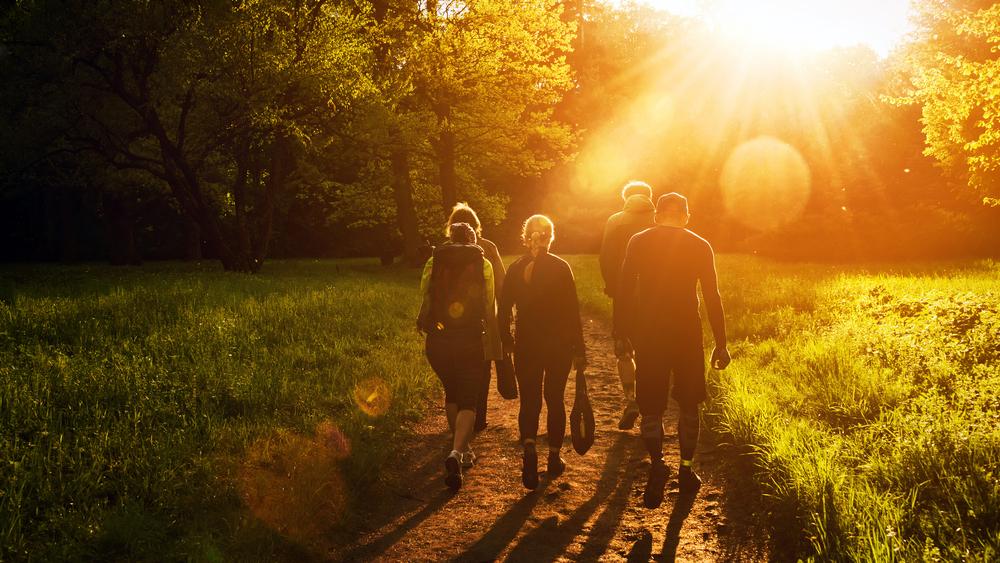
The practice itself is deceptively simple. You walk slowly, tuning in to colours, textures, patterns and sounds. You might gently touch a leaf or notice the intricate veins on its surface. While guides offer gentle prompts, most of the session unfolds in silence, giving space for quiet observation and a companionable silence with your fellow walkers.
Although Japan’s version of forest bathing is grounded in Shinto, a nature-based tradition that encourages reverence for the natural world, and supported by a culture that embraces slowness, it doesn’t easily carry over to Western life. Busy routines, scarce access to ancient woodland and limited workplace support often make it difficult to prioritise time outdoors, especially for something that can seem unproductive, overly spiritual or indulgent.
Bringing Forest Bathing to Local Parks
That’s where the ParkBathe movement stepped in. Founded in 2021 after a citizen science study tested a shortened, more accessible forest bathing model, ParkBathe offers bite-sized moments of reconnection using local parks and green spaces. Since it became a community-led project, over 1,200 people have taken part in free walks across Southeast London.
The ParkBathe study revealed some surprising results; chief among them, that it didn’t matter whether a green space was noisy or a little unkempt. When participants focused quietly on natural stimuli, they tuned in only to what delighted them. The study, which ran over a three month period, saw anxiety levels drop by 39% overall and rumination (those annoying looping and intrusive thoughts many of us experience) fell by 50% overall.
Perhaps more unexpectedly, participants also reported a 27% increase in feelings of social connection. Even though the walks were silent, many described a quiet sense of togetherness. Less surprisingly, there was also a 37% increase in connection to nature.
One reason for these effects may lie in how our attention begins to shift in green spaces, especially when we slow down and allow ourselves to simply be there, without rushing, chatting, or staying task-focused. Attention Restoration Theory (ART), developed by Rachel and Stephen Kaplan, suggests that natural environments engage us through what they call “soft fascination” – a gentle, effortless kind of attention that holds our focus without demanding it. Unlike the constant, high-stimulus demands of urban life and screen time, this quality of attention calms the nervous system and helps clear mental clutter, in turn creating space not only for restoration, but also for subtle moments of connection.
Nature also surrounds us with fractals, which are repeating patterns found at different scales in tree branches, leaves clouds and coastlines. These visually complex yet harmonious forms (even found in snowflakes and within the human body) are thought to be especially soothing to the brain, holding our gaze in a way that is both stimulating and restful and complementing the kind of attention ART describes.
And these benefits aren’t limited to forest bathing. Community gardeners know much of this instinctively. Whether tending to raised beds in a park or caring for planters on a busy roadside, these spaces offer more than just weeding or cutting back, they offer opportunities for reflection. When the digging pauses and someone notices the way the winter light hits a leaf, the sound of bees moving between flowers or a bud unfurling, they too are practising a quiet form of restoration.
Even amidst tools and tasks, there’s space for stillness. A few minutes spent simply observing, letting yourself be rather than do, can gently shift not just how we grow things, but how we grow ourselves in subtle, often unexpected ways.
A Path to Everyday Wellbeing
This is where forest bathing quietly lingers long after the session ends. Over time, the sensory practices begin to thread themselves into daily life. People find they pause at bus stops to watch the sway of a nearby branch, notice how sunlight filters through lime-green leaves on a tree they’ve walked past for years. Or perhaps they water a houseplant with a little more presence while the kettle boils. What was once overlooked begins to reappear. Nature stops being a backdrop or decoration and becomes something immersive, immediate and everywhere. It’s not a practice you leave behind, it’s a gentle recalibration that brings a little wildness into the everyday.
By its very nature, forest bathing makes a perfect companion to gardening and working outdoors, by pairing green activities with a new kind of pausing. Not a tea break (though that’s vital too), but a deliberate moment to step back, slow down and let the garden tend you.
After all, forest bathing is really an exercise in attention – of noticing more, not pruning things out. The Kaplans, pioneers in environmental psychology, described this as the kind of effortless attention nature demands, which gently restores our mental resources and re-fills our cup.
Simple Forest Bathing Techniques You Can Try Today
The good news is that you don’t need to travel or be in a forest or woodland to practice the simplified version of forest bathing that ParkBathe teaches. A treelined street, a quiet patch in a community garden or even an unruly row of pots will do. Here’s a simple way to begin:
- Stop doing. Put down your tools.
- Choose one sense. Try listening, really listening, for 60 seconds with your eyes closed. Then switch to sight, smell or touch in turn spending 60 seconds really noticing details.
- Walk slower than you ever have. One step every few seconds. It will feel strange at first, but stick with it. See what reveals itself.
- Let your gaze soften. That shift from focused to panoramic vision helps calm the nervous system, as it is intuitively connected to our visual and threat systems.
- Linger. Don’t rush. Let nature come to you.
Parkbathe participants often report better sleep and reduced anxiety, with effects lasting up to two weeks. It’s not about seeing more, but paying attention – and once you start, it’s hard to stop.
Next time you’re at your patch, planter or park, try gifting yourself five minutes to simply do nothing. Sometimes, the deepest growth happens when we stop tending our gardens and tend to ourselves.
Content supplied by...